Introduction
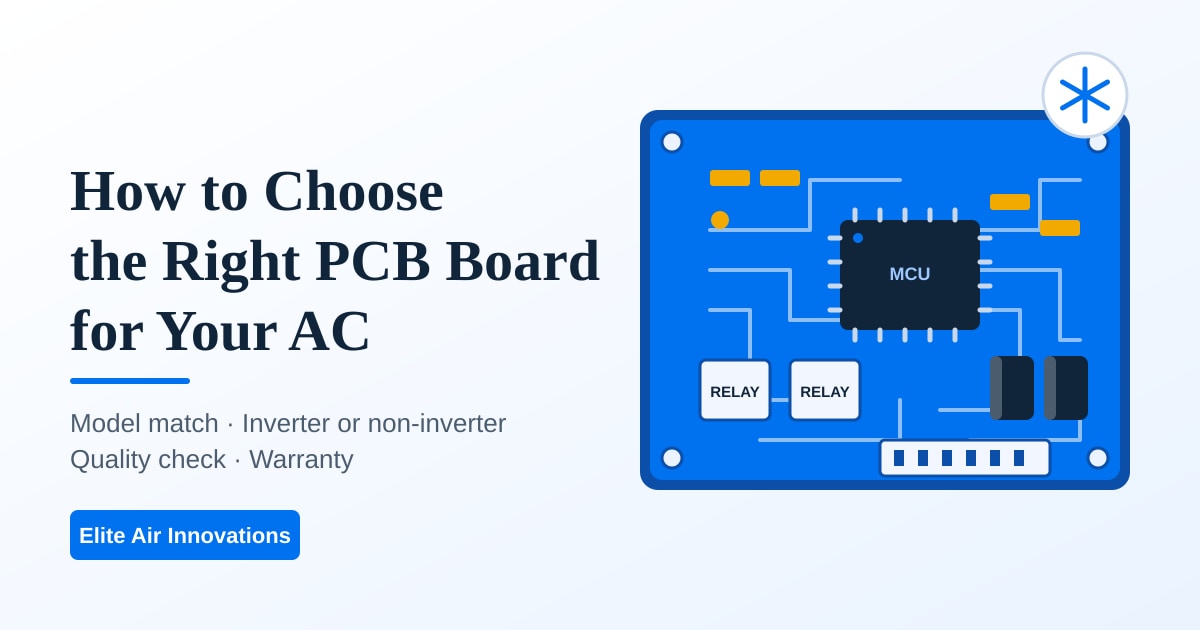
The PCB (printed circuit board) is the brain of your air conditioner. It reads the room temperature, controls the compressor and fan, receives signals from the remote and keeps the whole system running safely. When the PCB fails, your AC may stop cooling, turn off on its own, blink error codes or not start at all.
Buying the wrong replacement board can waste money and even damage other parts. This guide explains how to choose the right PCB board for your AC, step by step.
What Does an AC PCB Do?
An AC PCB controls the main functions of the air conditioner. It switches the compressor and fan motor on and off, manages the thermostat and sensors, runs the swing and timer functions and protects the unit from faults. In an inverter AC, the PCB also controls compressor speed, which saves electricity and keeps the temperature steady.
Types of AC PCB Boards
Indoor unit PCB: Sits inside the indoor unit. It receives remote signals, reads the room sensor, controls the indoor fan and shows the display lights or error codes.
Outdoor unit PCB: Sits in the outdoor unit. It controls the compressor and the outdoor fan motor.
Inverter PCB (power module board): Used in inverter ACs. It controls compressor speed and is usually more advanced and costlier than a non-inverter board.
Display and receiver board: A small board that shows the temperature and receives the remote signal. It is cheaper to replace than the main board.
How to Choose the Right PCB Board for Your AC
- Match the brand and exact model number
Every AC brand and model uses a specific board design. Note the complete model number from the sticker on the indoor and outdoor unit, not just the brand name. - Check the PCB part number
The old board usually has a part number printed on it. Matching this number is the safest way to get the correct replacement. - Choose the correct type: inverter or non-inverter
An inverter board will not work in a non-inverter AC, and the reverse is also true. Confirm the type before buying. - Confirm the tonnage and capacity
A 1 ton, 1.5 ton and 2 ton AC can use different boards. Capacity must match. - Check the connectors and terminals
The number of pins, plug shape and position should match your existing wiring. A board that needs wire cutting or modification is a warning sign. - Decide between OEM, compatible and universal boards
OEM (original) boards are made for your exact model and usually give the best reliability and warranty. Compatible boards can work if they are built for your model and tested properly. Universal boards need settings and wiring changes, so they are best handled by an experienced technician. - Look at build quality
Check that the board has clean soldering, neat component placement, good-quality relays and capacitors and a protective coating against moisture and dust. Poor finish often means a short life. - Ask about warranty and testing
A reliable seller should offer a warranty and confirm that the board is tested. Keep the invoice.
Check Before You Replace the PCB
Many AC problems that look like PCB failure are caused by something else, such as a faulty capacitor, bad sensor, loose wiring, a weak remote or unstable power supply. A qualified technician should test the unit first. Replacing the board without diagnosis can cost you money and the fault may remain.
Common Signs Your AC PCB Needs Replacement
AC does not turn on even with power. Remote does not respond. Compressor or fan does not start. AC turns off suddenly or restarts repeatedly. Error codes keep appearing. Burnt smell or visible burn marks on the board. Display or indicator lights behave strangely.
Mistakes to Avoid
Buying only by brand name without checking the model. Choosing the cheapest board with no warranty. Mixing inverter and non-inverter boards. Installing the board yourself without experience, which can damage it or cause a safety risk. Ignoring voltage fluctuation, which is a common cause of PCB failure.
Tips to Make Your AC PCB Last Longer
Use a voltage stabiliser where the power supply is unstable. Service the AC regularly so dust and moisture stay out. Keep the outdoor unit covered from direct rain. Do not switch the AC on and off repeatedly. Get repairs done by trained technicians.
Frequently Asked Questions
Can I use any PCB board in my AC?
No. The board must match the brand, model, type (inverter or non-inverter) and capacity of your AC.
Is a universal AC PCB a good option?
It can work, but it needs correct setup and wiring. It is best installed by an experienced technician.
How much does an AC PCB replacement cost?
The cost depends on the brand, model and whether it is an indoor, outdoor or inverter board. Ask for a written quote before the work starts.
How long does an AC PCB last?
With stable power and regular servicing, a good-quality board can last many years. Voltage fluctuation, moisture and pests can shorten its life.
Should I repair or replace a faulty PCB?
Minor faults, such as a burnt relay or capacitor, can sometimes be repaired. If the board is badly damaged, replacement is safer.
Conclusion
Choosing the right PCB board for your AC comes down to matching the model, part number, type and capacity, and buying a well-built board with a warranty. Always get the fault diagnosed before replacing it.
Need help choosing the correct PCB for your AC? Visit Elite Air Innovations (https://eliteairinnovations.com/) or contact our team for guidance.