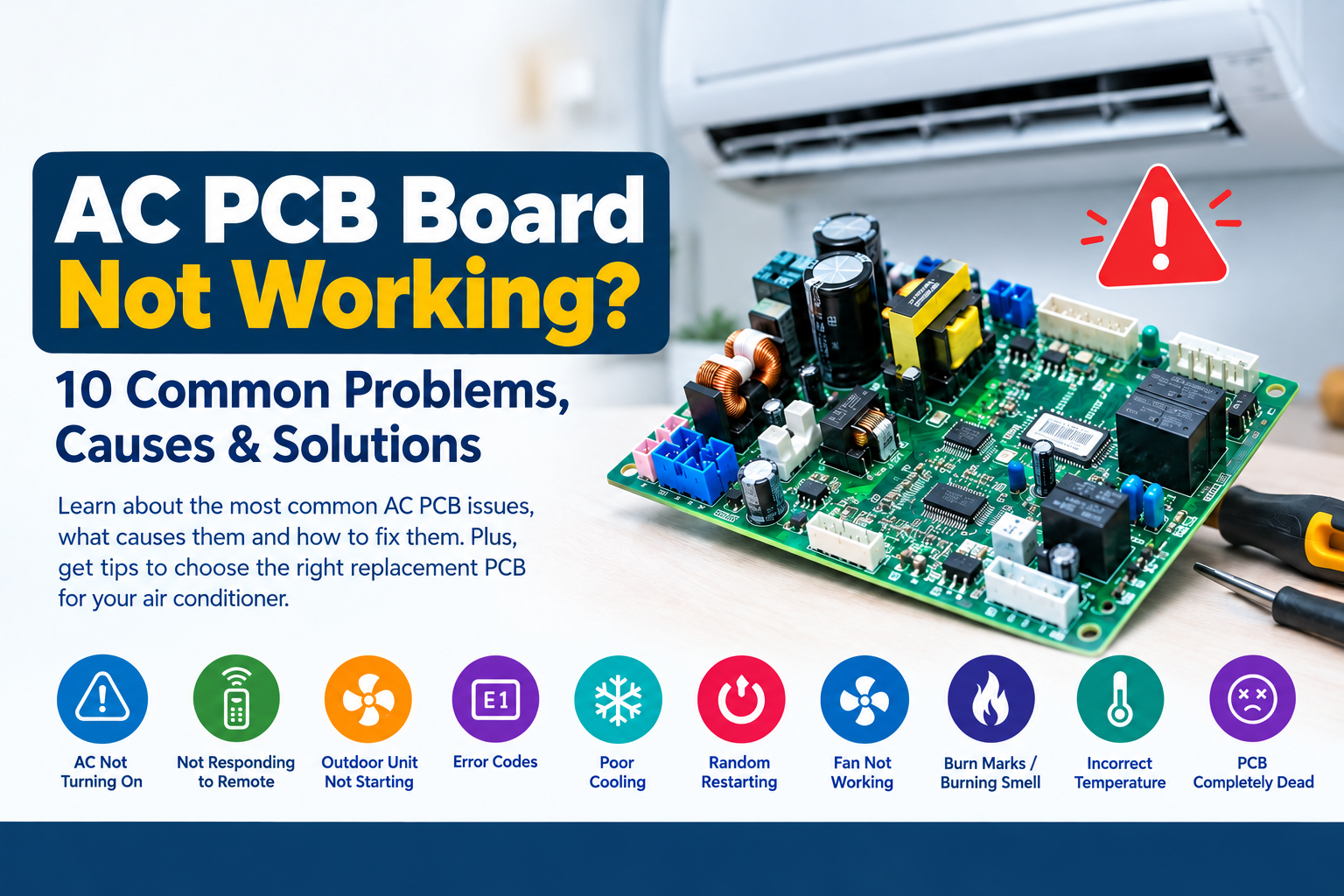
Your air conditioner may suddenly stop working, fail to respond to the remote, show an error code, or run without cooling properly. While there can be several reasons behind these problems, a faulty AC PCB board is one of the most common causes.
The Printed Circuit Board (PCB) acts as the control center of an air conditioner. It manages important functions such as power supply, temperature sensing, compressor operation, fan control, communication between indoor and outdoor units, and other electronic components.
When the PCB develops a fault, the AC may behave unexpectedly or stop working completely.
In this guide, we will discuss 10 common AC PCB board problems, their possible causes, and practical solutions. We will also explain when repairing the PCB may be possible and when replacing it with a compatible AC PCB board is the better option.
What Is an AC PCB Board?
An AC PCB board, or Printed Circuit Board, is an electronic control component inside an air conditioner. Depending on the AC model, there may be separate PCBs for the indoor unit, outdoor unit, display/control system, or power section.
The PCB receives signals from different sensors and components and controls various AC functions.
For example, it can control:
- Compressor operation
- Indoor fan motor
- Outdoor fan motor
- Temperature sensors
- Power supply
- Display and indicators
- Remote-control communication
- Indoor and outdoor unit communication
- Protection and safety functions
Because the PCB controls so many functions, even a small electronic fault can affect the overall performance of the air conditioner.
10 Common AC PCB Board Problems, Causes & Solutions
1. AC Is Not Turning On
One of the most common signs of a PCB-related problem is when the AC does not turn on even though the power supply is available.
Possible Causes
- Damaged PCB components
- Blown fuse on the PCB
- Power supply problem
- Burnt circuit or component
- Voltage fluctuation
- Faulty relay
- Internal PCB short circuit
Solution
First, check whether the AC is receiving power. You can also check the circuit breaker and power connection.
If the power supply is normal but the AC still does not respond, the PCB should be inspected by a qualified AC technician.
If the PCB has severe damage, replacing it with the correct compatible PCB board may be more reliable than repairing individual components.
2. AC Turns On but Does Not Respond to the Remote
Sometimes the AC receives power and the display may work, but it does not respond correctly to the remote.
Possible Causes
- Faulty IR receiver
- PCB communication issue
- Damaged PCB component
- Remote-control problem
- Wiring or connector issue
Solution
Start by checking the remote batteries and make sure the remote is transmitting properly.
If the remote works but the AC does not respond, the receiver and indoor PCB should be checked.
A technician can determine whether the issue is with the receiver, wiring, or the PCB itself.
3. AC Indoor Unit Is Running but Outdoor Unit Is Not Starting
If the indoor fan is operating but the outdoor unit does not start, the problem may involve the outdoor PCB or communication between the indoor and outdoor units.
Possible Causes
- Outdoor PCB failure
- Communication error
- Faulty relay
- Wiring problem
- Voltage issue
- Sensor fault
- Compressor protection
Solution
Check the power supply and wiring connections first.
If the indoor unit is functioning but the outdoor unit is not receiving the correct signal, the outdoor PCB and communication circuit should be inspected.
For inverter air conditioners, the PCB plays an especially important role in controlling the outdoor unit and compressor.
4. AC Is Showing an Error Code
Modern air conditioners often display error codes when they detect a problem.
An error code may indicate an issue with:
- Temperature sensors
- Communication
- Fan motor
- Compressor
- Voltage
- PCB
- Other electronic components
Solution
The exact meaning of an error code depends on the brand and model of the AC.
Do not automatically assume that every error code means the PCB needs replacement. A technician should diagnose the actual cause before purchasing a new board.
If the PCB itself is confirmed to be faulty, always select a replacement board based on the AC’s model number, PCB part number, and specifications.
5. AC Is Not Cooling Properly
Poor cooling does not always mean that the PCB is faulty. However, in some cases, a PCB problem can prevent the compressor, fan, or other components from operating correctly.
Possible Causes
- Faulty PCB
- Compressor control issue
- Faulty temperature sensor
- Fan control problem
- Refrigerant-related issue
- Dirty filters or coils
- Other mechanical problems
Solution
Before replacing the PCB, check the basic causes of poor cooling, including filters, coils, refrigerant, fan operation, and compressor performance.
If these components are working correctly but the control signals are incorrect, the PCB should be inspected.
Important: A PCB should not be replaced simply because an AC is not cooling. Proper diagnosis is essential.
6. AC Randomly Turns Off or Restarts
Does your AC suddenly switch off, restart, or behave unpredictably?
This can sometimes be caused by an electronic control problem.
Possible Causes
- PCB malfunction
- Voltage fluctuation
- Faulty relay
- Overheating electronic components
- Loose wiring
- Sensor problems
- Power supply instability
Solution
Check the electrical supply and connections first.
If the AC continues to restart even when the power supply is stable, the PCB and related components should be professionally inspected.
Repeated voltage fluctuations can also damage electronic components, so using appropriate electrical protection may help prevent future damage.
7. AC Fan Is Not Working Properly
The indoor or outdoor fan may fail to start, run continuously, or operate at an incorrect speed.
Possible Causes
- Fan motor problem
- Capacitor issue
- PCB fault
- Wiring problem
- Speed-control circuit failure
- Sensor issue
Solution
A technician should first determine whether the fan motor itself is working correctly.
If the motor and wiring are functioning properly but the PCB is not sending the correct control signal, the PCB may need repair or replacement.
8. PCB Has Burn Marks or a Burning Smell
Visible burn marks, melted components, or a burning smell are serious warning signs.
Possible Causes
- Electrical short circuit
- Voltage surge
- Overheated components
- Damaged capacitor
- Relay failure
- Water or moisture damage
- Component failure
Solution
Turn off the AC and disconnect the power before further inspection.
Do not continue operating an AC with a visibly burnt PCB.
A technician should inspect the board and determine whether it can be safely repaired or whether a replacement PCB is required.
When replacing a burnt board, it is also important to identify the original reason for the failure. Otherwise, the replacement PCB could suffer the same damage.
9. AC Is Showing Incorrect Temperature or Behaving Abnormally
If the AC does not maintain the selected temperature or behaves differently from the set mode, the problem may involve sensors or the control PCB.
Possible Causes
- Faulty temperature sensor
- Sensor wiring problem
- PCB processing issue
- Communication problem
- Control circuit fault
Solution
Check the temperature sensor and its wiring.
If the sensor is working correctly but the PCB is not processing the signal properly, the PCB may require repair or replacement.
10. AC PCB Is Completely Dead
In some situations, the PCB may show no signs of operation at all.
The AC may have:
- No display
- No response to remote
- No fan operation
- No control functions
- No communication
Possible Causes
- PCB power-section failure
- Blown fuse
- Burnt component
- Short circuit
- Severe voltage surge
- Water damage
- Internal PCB failure
Solution
A qualified technician should test the PCB and power supply.
If the board has extensive damage or cannot be repaired reliably, replacing it with a compatible PCB is often the better solution.
How Do You Know If Your AC PCB Needs Replacement?
Not every AC problem requires a new PCB.
However, PCB replacement may be considered when:
- The PCB has severe burn damage
- The board has repeated electronic failures
- Important components are damaged
- The PCB is not sending the required control signals
- The board has suffered major voltage damage
- Repair is not economically practical
- A compatible replacement PCB is available
Before purchasing a replacement, always confirm the compatibility of the board with your air conditioner.
How to Choose the Correct AC PCB Board
Buying the wrong PCB can lead to compatibility problems and may prevent the AC from working correctly.
Before ordering an AC PCB board, check the following information:
1. AC Brand
Identify the manufacturer, such as:
- LG
- Daikin
- Voltas
- Samsung
- Blue Star
- Lloyd
- Gree
- Haier
- Mitsubishi
- Panasonic
- Carrier
- Godrej
- Hitachi
- O General
- ONIDA
- Voltas
- Whirlpool
2. AC Model Number
The exact model number is one of the most important details when selecting a replacement PCB.
3. PCB Part Number
If possible, check the part number printed directly on the existing PCB.
4. Indoor or Outdoor PCB
Make sure you are purchasing the correct board for the required unit.
An indoor PCB and an outdoor PCB are not interchangeable unless specifically designed for the same application.
5. AC Type
Check whether your AC is:
- Inverter
- Non-inverter
- Split AC
- Window AC
- Other specific configuration
6. PCB Specifications
Compare the board specifications, connectors, layout, and other relevant details before ordering.
AC PCB Repair vs Replacement: Which Is Better?
PCB repair can sometimes be possible if only a small component has failed.
However, replacement may be preferable when the board has extensive damage or when reliable long-term operation is important.
| Situation | Recommended Approach |
|---|---|
| Minor component failure | Repair may be possible |
| Burnt PCB | Professional inspection/replacement |
| Severe voltage damage | Replacement may be better |
| Repeated PCB failure | Investigate root cause and consider replacement |
| Obsolete/unavailable PCB | Repair may be an option |
| Compatible replacement available | Replacement can be considered |
The best option depends on the actual condition of the PCB and the AC model.
Why You Should Not Buy an AC PCB Based Only on Appearance
Two PCBs can look very similar but have completely different programming, connectors, components, or compatibility.
Therefore, don’t select a PCB simply because:
- It has the same physical size
- It looks similar
- It has similar connectors
- It belongs to the same AC brand
Always verify the model number and PCB part number whenever possible.
Buy Compatible AC PCB Boards & Air Conditioner Spare Parts
If you are looking for a replacement AC PCB board, selecting the correct and compatible part is essential for reliable performance.
At Elite Air Innovations, you can explore AC PCB boards and other air conditioner spare parts for different brands and models.
Whether you need an indoor PCB, outdoor PCB, inverter AC PCB, or other AC spare parts, always verify the product compatibility before placing an order.
Explore our AC PCB Boards collection to find replacement options for your air conditioner.
Frequently Asked Questions
What are the signs of a faulty AC PCB?
Common signs include the AC not turning on, random restarts, communication errors, outdoor unit failure, incorrect fan operation, error codes, and visible PCB damage.
Can an AC PCB be repaired?
Some PCB faults can be repaired depending on the damaged component and board condition. However, severely damaged PCBs may need replacement.
How do I know which PCB is compatible with my AC?
Check the AC brand, exact model number, PCB part number, indoor/outdoor unit, AC type, and board specifications before purchasing.
Can a faulty PCB cause an AC to stop cooling?
Yes, in some cases a PCB fault can prevent the compressor, fan, sensor, or other components from operating correctly. However, poor cooling can have many other causes as well.
Is an inverter AC PCB different from a normal AC PCB?
Yes. Inverter air conditioners generally use specialized electronic control systems to regulate compressor and other component operation. Therefore, the PCB must be specifically compatible with the AC model.
Should I replace the PCB myself?
AC PCBs involve electrical components and potentially dangerous voltages. Diagnosis and replacement should be performed by a qualified technician.
How long does an AC PCB last?
There is no fixed lifespan. PCB life depends on factors such as electrical supply, voltage fluctuations, heat, moisture, usage, component quality, and overall AC conditions.
Final Thoughts
An AC PCB board is one of the most important electronic components in a modern air conditioner. When it fails, the symptoms can range from minor operational problems to a completely dead AC.
However, not every AC problem is caused by the PCB. Proper diagnosis should always be performed before purchasing a replacement board.
If your technician has confirmed that the PCB is faulty, make sure you select a replacement based on the exact AC model and PCB part number rather than appearance alone.
With the right compatible PCB and proper installation, you can restore your air conditioner’s electronic control system and get it operating properly again.